Goal
My goal as a supervisor is to contribute to my students’ progress in such a way that, under the condition that they work hard, ALL of them can become professional researchers. Here, I define “professional” as the competence to do honest and rigorous research publishable in a reputable academic journal (e.g., international journals listed in the SSCI) and the ability to maintain balance in multiple aspects of life (e.g., work, personal life, family life). To this end, I supervise graduate students by contributing to their project as the closest collaborator and often the first peer-reviewer, following the general procedure of experimental research described here.
My expectations and students’ responsibilities
I am committed to providing students with guidance, feedback, and opportunities for academic growth. However, students are ultimately responsible for meeting the academic and research standards required for their degree. Enrollment in my lab does not guarantee graduation, as degrees are awarded based on demonstrated achievement as shown below:
Master’s students, by the time they complete their degree, should be able to
- understand how to design basic psycholinguistic experiments.
- read and understand published research papers accurately.
- perform statistical analyses using R with some supervision.
- write an experimental research paper in an appropriate format.
Doctoral students, by the time they complete their degree, should be able to
- read and understand published research papers accurately and evaluate them critically
- perform statistical analyses using R with singlehandedly.
- write two ore more experimental research papers in English.
- develop original research questions and design experiments independently.
- respond to reviewers' comments with minimal supervision.
- conduct research independently and continue working in academia beyond the doctoral program.
- develop expertise that exceeds (or at least equal to) that of their supervisor, at least within their specific area of research.
Individual meetings
I meet students individually every week for about 90 minutes. When there is a need (e.g., intense data analysis session, final manuscript check, students’ request), indvidual meetings may last for several hours. Even when students have nothing special to report, they are advised to come to the meetings evey week for a chat (e.g., reporting their lack of progress and/or sharing their life stories).

Weekly lab meetings
Lab members get together once a week for a group meeting. In our weekly lab meetings, we report our progress (or lack of progress) and discuss psycholinguistic and life issues.


Meeting notes
Every time students participate in an individual meeting or a lab meeting, they submit a meeting note, reporting what they accomplished and how much time they (we) invested. The meeting notes are valuable data for me to keep track of many things such as what we worked on, how much time students (we) have put into research throughout a year, and how long meetings have lasted on average.

Communication through LINE or email
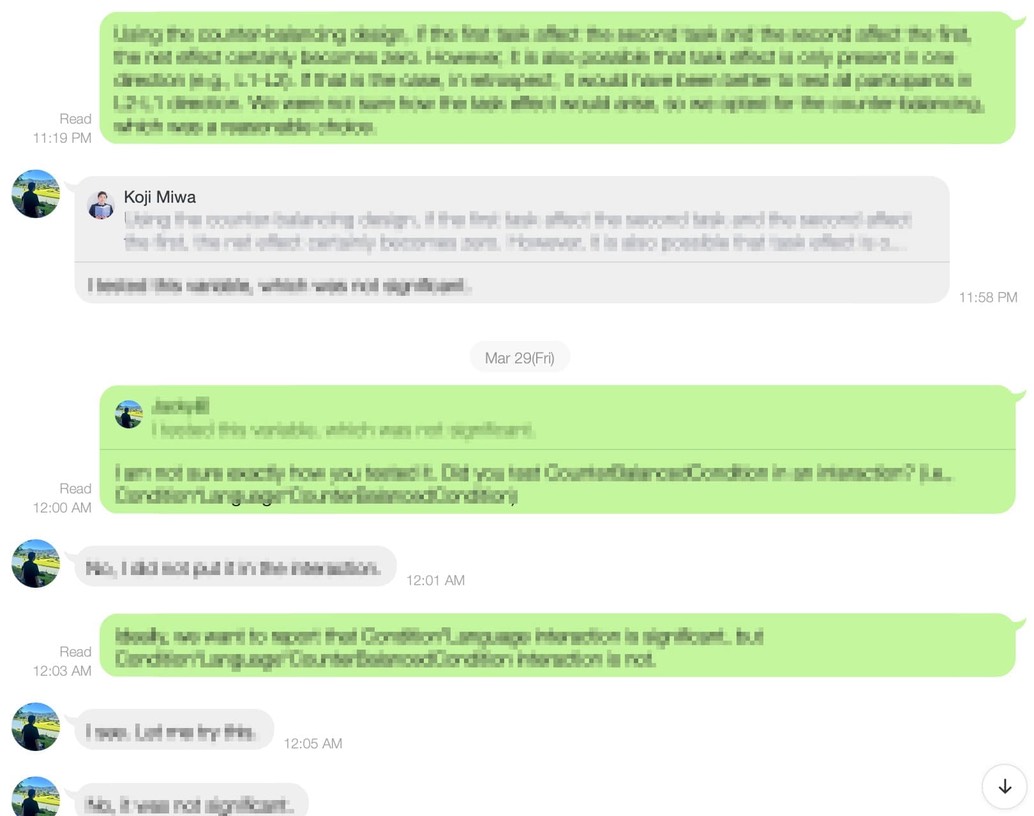
Students may also communicate with me via LINE and/or email. Regardless of their first language, written academic communication is done entirely in English to prepare students for future publications in English. I prefer to communicate using clear and direct language. I expect the same from my students. I do not appreciate dishonesty, abusive language, and frequent sarcasm.
Financial support
Conducting experiments requires time and energy, but it also requires money. It is my policy that I do my best to cover the financial cost for students’ experiments so that the scale of their project does not become unnecessarily small. However, this is not 100% guaranteed, and whether I can follow my policy depends on a number of factors: (1) how many students I am supervising, (2) how many participants are required for the proposed projects, (3) whether it is a second run of the same experiment after inadvertent mistakes on the part of the students. Unfortunately, I cannot support students’ travel costs to participate in conferences. However, students are encouraged to apply for scholarships and financial supports outside the lab.
Troubleshooting
My supervision style presented above, when it is described by me on my personal website, may look more effective and attractive than it actually is. However, we humans cannot always make steady progress in the way we hope. For continuous improvement, I keep updating my academic knowledge and my life philosophy. I also appreciate students’ feedback on my supervision. At the same time, students should also be aware that the freedom and right to change their supervisor (simply fill out this 指導教員変更届 form and submit it to 総務課) is always at their disposal. Students are free to leave the lab and seek supervision elsewhere if they feel that my supervision style does not satisfy their needs.
Acknowledgment
I thank Professors Gary Libben, Harald Baayen, Ton Dijkstra, Patrick Bolger, Sally Rice, and Terrance Nearey for having shown me professional examples of supervision.